
Mesonet Ticker for September 10, 2026
MESONET TICKER ... MESONET TICKER ... MESONET TICKER ... MESONET TICKER ...
September 10, 2026 September 10, 2026 September 10, 2026 September 10, 2026
Boom goes the dynamite

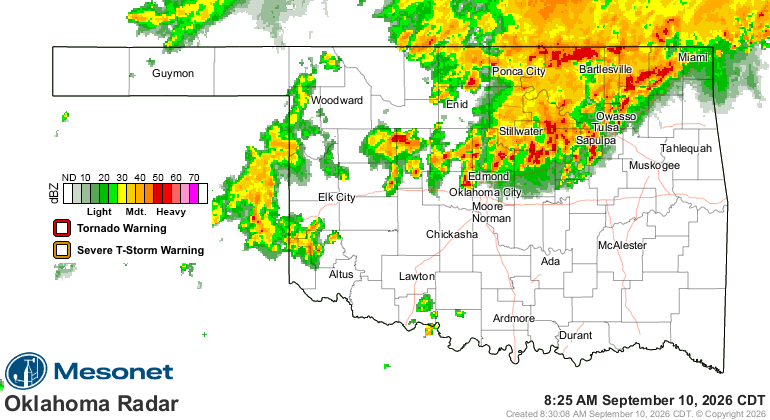
Yeah, put that in your rain gauge and....ummmm, smoke it, Mother Nature! Not sure
that worked, but you get my drift. Heck (yes, it is raining right now, for crying
out loud!), the rain is great, but I'm really here for the highs in the 80s!

Sorry, southern Oklahoma. Well I didn't tell you to live there! Besides, you are
also warmer in January, so you have that going for you. But for most of us, didn't
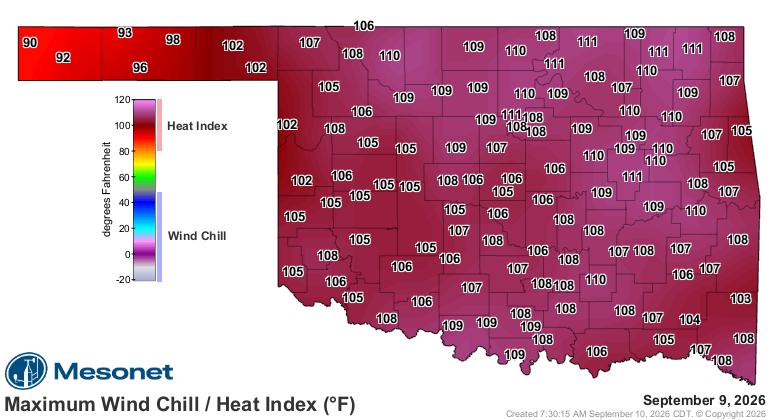
yesterday feel like the hottest day of the year? No, not on the scoreboard, but
just in a "it's September 9th and we have a cooldown coming tomorrow but this
is still wayyyyyy too hot!" kind of a way?
We're not quite out of the woods just yet, but things look to be trending more
pumpkin-spice'ish as we head later into the end of next week. But, the heat
returns tomorrow and hangs around awhile longer, in between fits of much-needed
rainfall.


Of course, if you're getting rain and clouds (there's medicine for that), then
your temps will be milder for sure. But like I said, there are indications of
a much bigger cooldown coming for the end of next week. It might just be down
to "normal" territory, as in lower- to mid-80s, but who here is willing to turn
that down?
Now let's go a big farther out, and away, to the equatorial Pacific waters. Our
old buddy El Nino is still going strong, and it's still expected to become
"very strong" by this winter...a 98% chance it will exceed that 2C positive
anomaly in the October-December 3-month period to be labeled "very strong."

And there is also a 75% change this event will be "historic," or the strongest
El Nino since 1950. This might be a good place to discuss these terms a bit.
When you see the term "super" El Nino, that's analogous to "very strong." It
doesn't mean the strongest event on record. That's reserved for "historic."
There will be a quiz later.
As always, we remind folks that the strength of the event doesn't mean stronger
impacts necessarily, but the chances of experiencing typical El Nino impacts
are greater. For us, wetter than normal conditions will be favored.
Another caveat...El Nino isn't the only thing influencing our weather from
far-flung areas of the globe. I've been keeping my eye on the Pacific Decadal
Oscillation (PDO), which has been in historically low territory. The PDO is
sort of a chicken or egg partner with ENSO. When it's negative (also known as
the cool phase), La Ninas tend to dominate. When positive phase...El Ninos are
favored. And it has been mostly negative over the last 25+ years, which is why
we've had so many of those stupid La Ninas, and so many of those damaging
droughts.
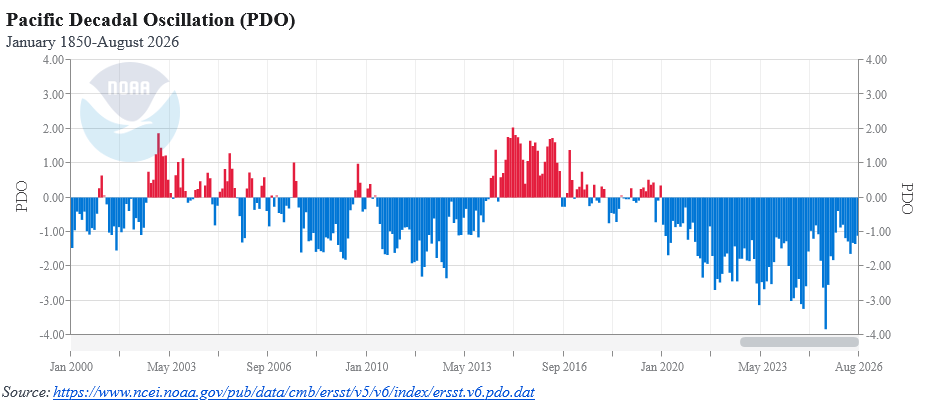
So we're officially in CRAZY territory with the combination of the two. But what
we DO know is that a strong El Nino is occurring in the equatorial Pacific
right now, and it is strongly coupled with the atmosphere. And it's expected to
get stronger.
So maybe all this is fixing to (Okie to English translation: "about to")
head in the other direction?


Gary McManus
State Climatologist
Oklahoma Mesonet
Oklahoma Climate Survey
gmcmanus@ou.edu
September 12 in Mesonet History
| Record | Value | Station | Year |
|---|---|---|---|
| Maximum Temperature | 105°F | ALTU | 2011 |
| Minimum Temperature | 40°F | BOIS | 2014 |
| Maximum Rainfall | 9.13 inches | FAIR | 2008 |
Mesonet records begin in 1994.
Contact the Ticker
Follow the Ticker via the Mesonet social media accounts on Bluesky, X, or Facebook, or subscribe to our RSS feed.
To subscribe to or unsubscribe from the Ticker mailing list, or for questions about the Ticker or its content, please contact the Ticker Manager at OCS:
(405) 325-2253